
Communication Matters in Delegated Design
Potential Impacts to Cost, Safety, and Your Reputation
Here’s something most structural engineers don’t realize until it’s too late: the biggest risk in delegated connection design isn’t technical expertise. It’s communication. When projects go wrong, the complaints about EORs rarely focus on design or structural analysis. Instead, they center on responsiveness, information sharing, and teamwork.
Poor communication in delegated design creates a cascade of problems:
- Inaccurate bidding
- Expensive change orders
- Project delays
- Damaged reputations
Part One in Advantage Structural Engineers’ series about safe and efficient delegated connection design explored the importance of creating detailed drawings. Our next post examines why communication matters more than you might think and how to get it right.
The Five Communication Channels in Delegated Design
Communication is the most neglected part of the delegated design process, yet it carries the highest risk. When you delegate connection design, you’re bringing another engineer onto your design team to handle a critical portion of your building. The connection designer becomes part of your team, and treating them as such changes everything about how the process works.
Communication in delegated design includes five critical channels:
- Structural drawings that provide essential design information
- RFIs that clarify ambiguities and answer technical questions
- Online meetings and phone calls for complex coordination
- Shop drawings that show how connections will be constructed
- Stamped connection design submittals with calculations and verifications
When any of these channels breaks down, the risk increases dramatically. But here’s the thing: you have the power to prevent this. By ensuring complete and accurate information is available, you empower the connection designer to perform their work safely and efficiently. You’ve reduced the need for assumptions and the problems that follow.
The Cost of Communication Failures
Financial Impact
Insufficient information on structural drawings leads to inaccurate bidding. When realistic reactions and schematic connection information are not accurately shown on the structural drawings, it either requires the fabricator to inflate their bid for anticipated worst-case scenario connections or underbid the project, knowing they will have the right to change orders after the bid is won. Both cases add costs to the project, which are passed on to the building owner.
Reputation Damage
General contractors have strong opinions about which EORs communicate well and which don’t. The complaints are generally not about how well an EOR designed a structure. They’re typically about communication and a lack of team mentality. When fabricators issue change orders for missing information, the structural engineer of record takes the blame. Those conversations reach owners, developers, and architects who hire engineers for future projects.
Project Delays and Safety Risks
RFIs pile up when information should have been on the drawings. Meetings get scheduled to resolve issues that should have been addressed up front. The most serious consequence is the safety risk. When the EOR and connection designer have different understandings about the scope, connections can go entirely undesigned.
In extreme cases, communication failures can lead to catastrophic consequences. We saw this in the 1981 Hyatt Regency Skywalk collapse. Caused by a design flaw due to miscommunication, the resulting collapse of two walkways killed 114 people and injured over 200. It serves as a stark reminder of the critical role of communication in delegated design.
Defining the Scope: Common Out-of-Scope Connections
Clearly defining the scope prevents dangerous gaps in design responsibility. Steel buildings involve numerous connections. Major ones like shear, moment, and brace connections, plus minor ones like kickers at spandrel beams. While the delegated design scope is usually clear for typical connections, certain elements create confusion.
Common out-of-scope connections include:
- Wall girts: HSS wall girts support horizontal, vertical, and torsional loads when supporting veneer. These complex load combinations and the use of HSS sections requiring slip-critical connections make them poor candidates for standard delegated design.
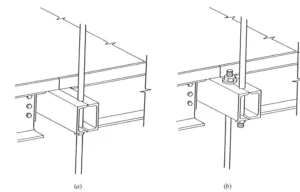
- Hangers: These specialized connections often require coordination with architectural elements and specific detailing that falls outside the typical connection design scope.
- Cantilevered canopies: The loading conditions and structural behavior of cantilevered elements typically require EOR involvement beyond standard connection design.
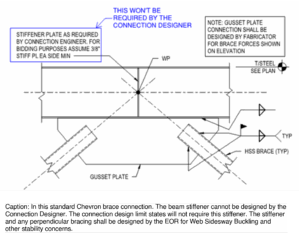
- Stability connections: Connections that have stability concerns and stability design checks need to be fully designed by the EOR based on the idealized support conditions.
When these gray areas aren’t addressed in the scope definition, both parties make assumptions. Clear scope statements on your structural drawings eliminate this ambiguity.
Shop Drawings and RFI Best Practices
Effective communication through RFIs and shop drawings requires practices that prevent delays and ensure accuracy.
Responding to RFIs
- Answer RFI requests promptly. Connection designers need this information to proceed safely.
- Provide complete answers rather than partial information that generates follow-up questions.
- Accept phone calls or online meetings when requested to resolve complex issues efficiently.
- Apply the same responsiveness standards you use with your in-house design team.
Shop Drawing Coordination
- Require the connection designer’s stamped submittal letter confirming that the shop drawings properly reflect the connection design.
- AISC’s Code of Standard Practice recommends that connection designers do not stamp shop drawings. This creates confusion about scope.
- Verify that discrepancies between engineered connections and construction documents are resolved before fabrication.
How Communication Matters for Your Reputation
Excellent communication differentiates your firm from competitors and builds your reputation across the industry. When you provide detailed information on structural drawings, answer RFIs quickly, and keep your expectations clear, you stand out.
Treat the connection designer like a member of the design team, not an outsider. You wouldn’t expect your in-house engineers to work without access to questions and collaboration. Connection designers need the same level of communication to do their job well.
Build your reputation through proactive communication practices:
- Anticipate questions and answer them in your drawings before they become RFIs
- Respond quickly and thoroughly to clarification requests
- Schedule calls or meetings to discuss complex issues
- Define the scope clearly to eliminate guesswork
- Provide realistic reactions and load information up front
Advantage’s delegated design services follow this same approach: clear communication from concept to completion. When the process runs smoothly, everyone benefits: the fabricator, the contractor, and the owner. You’ll earn a reputation for being easy to work with, and contractors and fabricators will remember you when choosing partners for future projects.
Your Next Steps
Communication in delegated design carries more risk than most engineers recognize. The technical design work matters, but communication failures cause more cost overruns and safety concerns than calculation errors.
Treat the connection designers as part of your design team. Be sure to provide thorough information across all five communication channels: structural drawings, RFIs, meetings, shop drawings, and design submittals. Your clarity will set you apart from competitors and build a reputation that attracts repeat business.
In our next post, we’ll cover best practices for specific connection types, including the technical details that make shear, moment, and brace connections work efficiently and safely.
Ready to improve communication on your next project? Contact Advantage Structural Engineers to discuss how our collaborative approach ensures smooth project execution and exceptional results.