
Historic Building Restoration That Preserves Character
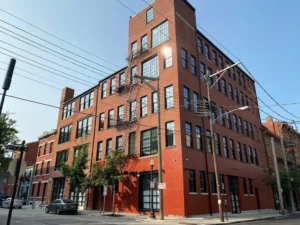
Restoring Cincinnati’s Over the Rhine
Over the Rhine (OTR) is a historic district in Cincinnati’s urban core. The name comes from German immigrants who settled in the 19th century, traveling back “over the Rhine” (the Miami and Erie Canal, now Central Parkway) after working downtown.
Over the Rhine has meant different things to different people. Some recall its history. Some think of fine dining and culture. Some think of vacant buildings. For the team at Advantage Structural Engineers, it has meant opportunity, restoration, and preservation.
Over the years we’ve completed countless projects throughout OTR. Italianate architecture dominates the neighborhood, and understanding 19th-century construction methods is critical to bringing these structures back to life while meeting modern codes.
These buildings present unique structural challenges:
- mass masonry walls
- cast iron columns and beams
- rough-sawn framing
- unclear lateral load paths above open storefronts
- shared party walls
- fire escapes critical for egress
Our goal is preserving character while prioritizing safety, use, and preservation.
We sat down with three of our engineers–Ray, Kyle, and Nate–who represent distinct eras of OTR restoration experience.
Why is Historic Building Restoration Important for Over the Rhine Projects?
Ray: Working on OTR projects has always felt different than new construction. These projects are personal, challenging and have a clear community impact. These buildings cause you to understand the load path and may be hanging on by a thread or on the verge of collapse and we can save them.
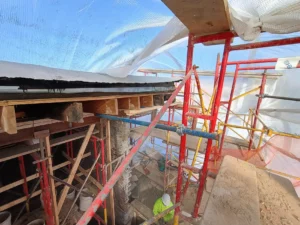
Kyle: With that there is a team mentality and forging of relationships that you don’t get in new construction. Contractors and tradesmen become trusted partners and there is real discussion happening back and forth between the engineer, the mason and the general contractor to help everyone get on the same page. After a successful project you get to keep coming back to the same team because there is mutual respect and trust among the team. It allows the opportunity to get to the heart of structural engineering and practice construction science rather than the engineer being off on an island without understanding the practice of construction or constraints of working on an existing building.
Ray: There has to be that team mentality. It forces us as engineers to really understand the limitations that the contractor sets out when we ask what can you do? Or what did you want to do here? And then we can formulate that into engineering or vice-a-versa where they formulate our engineering into execution. It’s often iterative and that process is great to pull back the curtain and truly understand where the other person is coming from.
How Do Engineers Approach 19th-Century Building Restoration?
Kyle: Preservation and restoration projects in OTR fit my approach to engineering. These projects allow the opportunity to come up with creative solutions and require visualization and approximation rather than getting lost in the code.
Ray: Preservation and restoration is important to me because it gives us the unique opportunity to enhance the area making it better and safer than it was. It is critical to understand and respect the materials and methods that were historically used. While the preservation of these buildings is being done we cannot force these buildings to behave like something they are not. For example mass masonry walls need to breathe and allow moisture to escape the walls. If we trap water in the walls of these buildings we will do more harm in the future.
Kyle: Right, preservation goes beyond the bottom line, it is an investment in the community and about the people that were there and will be there to enjoy, live and work in these spaces.
Ray: I love that about preservation and my appreciation for history: picturing who was in the building, what were they doing, what was life like back then? There is such unique craftsmanship too whether it is the intricacies of the masonry or stone detailing or the hand cut mortise and tenon joints in wood construction. I remember one project on Race Street had this 40 foot long continuous rough sawn beam. You’re not finding that in modern lumber unless it’s engineered these days.
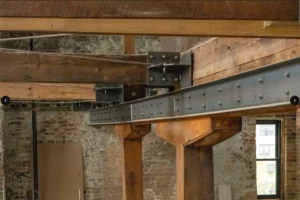
Kyle: Absolutely, there is such unique architecture here that we get to have a hand in restoring. Some other midwest cities have let neighborhoods like this fall by the wayside and continue to be neglected. I take pride in doing something about it and being a part of that restoration. Besides, when I travel I am drawn to areas like this in cities that have a natural and organic history and evolution, areas with character, not some block that was wiped clean and completely replaced with new construction.
Ray: For a time that was the thought with Urban Renewal when I was just starting out. To just tear down and start over after letting buildings deteriorate. I remember seeing shifts in that in the mid 90’s with interest in the micro breweries and revitalizing Main Street and working with the buildings that were already there. We had done a few roof top amenities on buildings during that time and that was enjoyable for me too because I went out and used those spaces as I got into working in this area.
Kyle: Yeah, my first exposure as a professional was mid to late 2000’s when working on Quan Hapa and our office was doing Mercer Flats across the street as well. This seemed like an effort by development and the city to re-establish Vine Street as a corridor and what led to what we know it to be today filled with restaurants and shops.
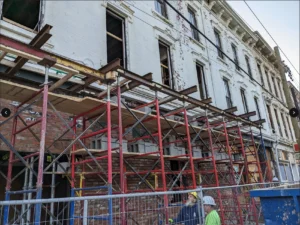
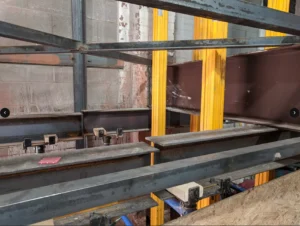
Nate: I got exposed to it mid 2010’s too and got to see first hand what you guys were talking about. Even on the first few projects I could sense the mutual trust and respect that you two had developed with different contractors, it really seemed like a personal relationship. It was so divergent from the clearly defined process and workflow of new construction, which can be much more sterile, if you will. One of my most memorable experiences as I was coming up was the Jackson Street Lofts project where there were significant shoring challenges and we had gone through multiple concepts and iterations to solve the problem and stabilize the building. Coincidentally this occurred during the initial onset of the COVID pandemic which only magnified the level of trust necessary within our own team internally and between the contractor and their subcontractors performing the work. Communication channels looked different, many of us were remote and site visits were more brief and ultimately the team was able to successfully execute a mutually agreed upon plan. To me it was a pivotal milestone in my time working in OTR.
What Advice Would You Give Engineers Working on Historic Buildings?
Kyle: If you allow yourself to treat everyone as a mentor you will be better off. If you write-off someone then you disadvantage yourself from a learning opportunity. You will learn so much more soaking in all the information you can from those around you. Trades in general are passed down from the previous generation, but restoration even more so is learned from knowledge passed down from forgotten methods and unique experiences, OTR is full of that.
Ray: Think about the load path, the engineering methods of the time were not complex elaborate codes. In the 1850’s they built based on prescriptive methods and many seemingly complex problems can be addressed when you use simple, appropriate assumptions and apply basic statics to the problem. This mentality does not discredit modern engineering and the benefits of current codes, rather it is a using an appropriate method for understanding what was done at the time and how it was and can be justified in engineering analysis.
Nate: As the youngest member of the table I think my emphasis would be to ask questions. We have all heard ‘there are no stupid questions’ or ‘the only stupid question is the one you don’t ask’ but there is truth in those statements and the majority of the people you encounter on jobsites like this are more than happy to explain their point of view or how they want to do things. Often they are willing to share their experiences and you can build on those as you experience renovations of these buildings too. Don’t be afraid to raise concerns either, if you can’t justify the analysis or understand the historic construction methodology then you have the chance to either learn or identify a problem that needs to be addressed.
Ray: This has been such a great discussion. It’s awesome reflecting back on the years and seeing each of your experiences and their parallels to my own and the history of Advantage working in OTR.
Kyle: I agree, it’s great just taking time too to be a tourist and come back to these places we spend so much time at during the day or on jobsites, but to come back at night and experience how a dilapidated building can come to life. It is such a vibrant area of growth and so cool to see these buildings in a different light, literally.
Nate: It’s meaningful to be a part of their history. I love putting our mark on these buildings. Hopefully we can keep doing it in a subtle, yet impactful way that allows these buildings and this neighborhood to continue to evolve and experience the next hundred years, with their previous heritage and age and repairs and strengthening that sets them up for the future.
What We Bring to Your Historic Building Restoration Project
Successful Over the Rhine projects require expertise across multiple areas of structural engineering. Advantage provides comprehensive services specifically suited to the challenges of historic building restoration:
Building Rehabilitation & Stabilization: Our primary focus for OTR work. We assess structural integrity, identify load path issues, and develop solutions that preserve historic character while meeting code requirements for existing building.
Structural Engineering: Full-service analysis and design for historic structures, including understanding of 19th-century construction methods and materials.
Construction Engineering: On-site collaboration during execution. We work alongside contractors, masons, and general contractors to solve problems iteratively and ensure your vision is realized.
If you have driven through OTR lately, you will see it dotted with projects, but there is more work to be done. We are excited for the future of this area, and look forward to using our combined knowledge and experience to preserve and restore this pocket of Cincinnati that is so rich in history, architecture, and culture.
Schedule a Consultation to Discuss Your Historic Building
If you have an upcoming project in Over the Rhine and would like to discuss it with us, we’re ready to help. Our experience and knowledge of OTR is a source of pride and we look forward to being able to contribute to your next project.